
AppLovin: The AXON Engine That Could
Author: Rohit Sah, PhD
Published: November 17, 2025
APP is a company that helps mobile gaming companies make money. 40 million Americans play casual games on their phones on any day, mostly during a relaxed time of their day (think word games, Tetris, Candy Crush, Roblox etc. being played on weekends or evenings, commuting etc.). This is a demographic which was bound to become targets for advertising. Most gaming companies, however, are hard pressed to get paid for their games: after all, entertainment is a winner take all business. On the other side of the aisle, businesses have been stuck largely advertising through Google and Meta (Amazon is becoming a third force). This lacuna is starting to get filled by APP.
Gaming companies download APP’s software development kit (its SDK is branded MAX). MAX powers the ads inside games. Advertisers bid through AppLovin Exchange (ALX) aiming for a target audience. The most important asset of APP is their machine learning engine called AXON. AXON decides which ads to show, where and for how much. If a gamer taps, installs or buys, the advertising company pays. APP takes their cut, and the rest goes to the gaming company. This is seriously profitable business. For years, platforms like Reddit, Pinterest, SNAP and the like have tried to lure away ad dollars from Meta and Google, with little success. For some advertising clients APP has proven itself, and APP may become a third rail after Meta and Google.
The first point here is that APP owns the SDK, the auction & the exchange (ALX) and the optimization engine (AXON). This full stack is rare advertising technology with Meta & Google’s profitability deriving partly from their complete control over the ad process. Such full stack companies do not depend on the munificence of other companies (although APP is critically dependent on remaining in the good books of Apple and Google for permission to stay in their app stores).
The other point to note is that the immense profitability of APP comes mostly from AXON. Over years, APP has perfected their machine learning model so that the return on advertising on investment for their clients has proven themselves. Online advertising is a cutthroat business: advertisers will test a platform, see if it generates a good return on ad spending, and stop spending on that platform if it does not. AXON is what makes such companies keep coming back to APP for more.
For most of their existence, APP stuck to the gaming industry as they had little competition; Google and Meta had much fish to fry than go after what was previously seen as an “industry backwater”. About a year ago, APP started wondering if they could adapt their business model to e-commerce advertising. After running beta trails for several months with select ecommerce and direct to consumer brand companies, the verdict is clear: AXON worked just as well with ecommerce as it did with gaming. Even better, ecommerce user buying experiences improved AXON’s prediction as there are now data points from different uses. A woman buying a $5000 handbag apparently has a higher correlation with certain gaming activities. As of October 1, 2025, APP has opened their platform to all comers and the full financial impact should show up in 2026.
Early data from Northbeam (as reported by Deutsche Bank) suggests that APP’s incremental market share in digital ad markets has started growing; a remarkable development since APP opened up their platform to all comers only in early October. Please see the illustration below.
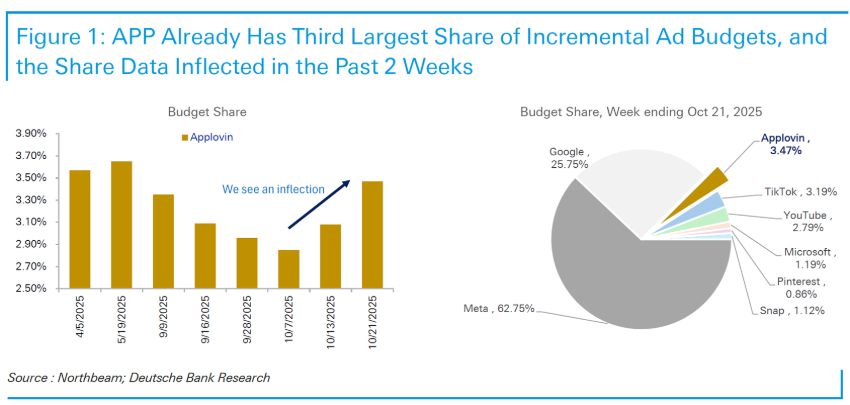
I doubt that online advertisers will cut their budgets on Meta or Google as these giant platforms are proven destinations for generating strong returns on ad spending. What is more likely to happen is that incremental ad spending will head more towards APP as the above chart illustrates. A 5% market share for APP would translate to an additional annual $13 billion in sales. Since sales in 2025 are estimated at $7 billion, an annual total of $20 billion would imply a net profit of over $12 billion. At an enterprise value of $190 billion today, that would mean APP is one of the lowest valued growth stocks in the US. Market share can easily go higher than 5% and the ecommerce market will continue to boom. My short-term target is $1000 compared to $557 as of market close on November 14, 2025.
The Short Sellers’ Claims
To summarize their thesis, it is all about how APP is abusing privacy rules set by Apple and Google and is therefore bound to get kicked out of their app stores. Short sellers also claim that APP is tracking people illegally, creating digital fingerprints; a big no-no in the ad world.
The financial smell test for fraud in any company goes through an analysis of their balance sheet and cash flow shows no problems whatsoever. Net debt is about 6 months of free cash flow. Accounts receivable days are a long 90+ days but accounts payable are even longer at 190 days; working capital is therefore negative for APP. APP has been generating gobs of free cash flow; $1 billion in just the last quarter. There is no smoking gun of fraud in the financial statements.
Moreover, the short sellers’ report never even discusses APP’s business. A summary would read: AXON sounds impressive but is not doing anything special. That is a stunning omission; AXON (along with the full stack ad model) is exactly why APP is doing so well in the cutthroat digital ad market.
As for privacy rules of Google and Apple being abused, these are perplexing claims. When Apple and Google do not like you, they do not make it a secret. These two companies actively monitor how their app stores are used, so short sellers are effectively accusing both Apple and Google of incompetence. Google kicks out 11,000 apps every day based on factors including privacy protection, and it is extremely unlikely that a major company like AppLovin would fall through the cracks in Google’s filters.
In general, all app companies do know many things about their user base (Facebook has reportedly 50,000+ data points on each of their users), and APP is no different. The question is what APP does with such information. Since APP does not have access to phone numbers or email addresses, it boils down to inference. What is happening at AXON is clever data analysis and machine learning. Its learning improves with fresh information. If a woman buys cat food after watching an ad on Candy Crush, that data point becomes an input into future AXON iterations. The AXON model works so well that short sellers cannot believe it is done without tracking every gamer. AXON has become an entire moat all by itself for AppLovin.
The market clearly disagrees with the short sellers’ reports which came out in March 2025. The share price was $325 the day before Muddy Water’s report came out. Ten months later, APP’s share price stands at $557. How long will it take for the market to start disregarding such misleading charges is the only question left to be answered.